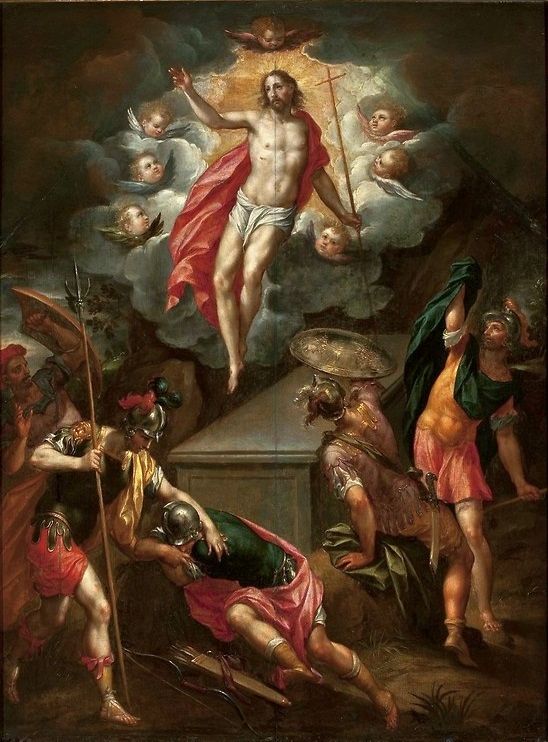
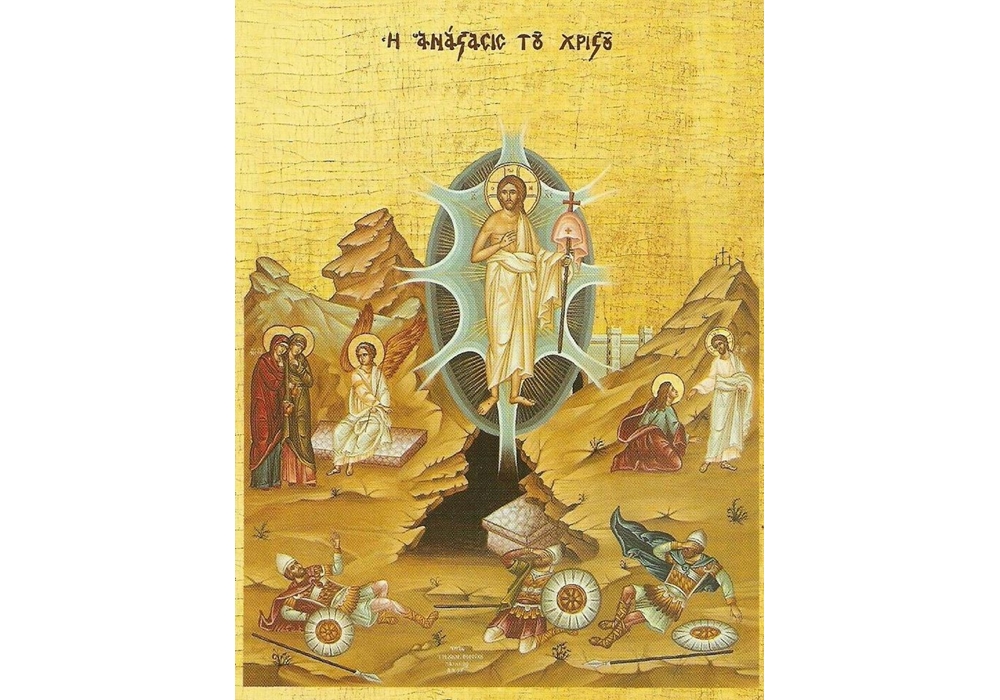
THE PASCHAL ANNUNCIATION
CHRIST IS RISEN !!!
A MOST BLESSED FEAST OF
THE RESURRECTION OF CHRIST !!!
“Let no man fear death,
for the Saviour’s death
hath set us free.”
(Paschal Catechetical Homily,
St John Chrysostom)
BELOVED BRETHREN AND SISTERS
IN THE RISEN LORD JESUS CHRIST,
“REJOICE!”
On this holy and most radiant night, wherein heaven and earth are joined together in one solemn triumph, the Church of Christ lifteth up her voice and publisheth those glad tidings which are not of this world, yet transfigure the world: “Death is swallowed up in victory” (1 Cor. 15:54). This selfsame victory hath been witnessed by the Apostles and defined in dogma by the First Ecumenical Council at Nicaea, in that confession whereby the Son was declared to be “of one substance” (ὁμοούσιον) with the Father: “Who for us men and for our salvation came down from heaven… and the third day He rose again according to the Scriptures” (The Niceno-Constantinopolitan Creed, 325/381). Thereafter it was finally and immovably confirmed by the Fourth Ecumenical Council at Chalcedon, which confesseth “one and the same Christ, Son, Lord, Only-begotten, acknowledged in two natures, without confusion, without change, without division, without separation… perfect in Godhead and perfect in manhood” (Definition of Faith, Chalcedon 451, Actio V; Mansi, VII, 111–116).
Thus, in steadfast fidelity to the patristic inheritance as expressed by St Cyril of Alexandria – “μία φύσις τοῦ Θεοῦ Λόγου σεσαρκωμένη,” that is, “one nature of God the Word incarnate” (Ep. ad Succensum, PG 77, 228) – the Church confesseth neither mixture nor confusion, but the unity of the Person of the Incarnate Logos. This the holy Council of Chalcedon did more fully declare, distinguishing the two natures without dividing them, and thereby preserving the fulness of salvation; for “that which He hath not assumed He hath not healed,” as St Gregory the Theologian proclaimeth, and in Christ the whole of human nature hath been assumed and restored.
To-day, therefore, we celebrate neither memory, nor notion, nor emblem, but an event which shook the very foundations of being itself: the Resurrection of our Lord Jesus Christ, through Whom life hath shone forth from the tomb, and incorruption hath been bestowed upon mankind, so that the old corruptible man is cast down and the new is put on. “Our old man is crucified with him” (Rom. 6:6); and we are bidden “put off concerning the former conversation the old man… and… put on the new man” (Eph. 4:22-24). This is already the co-being of man with God and in God; and it openeth before us the fulness of the resurrection of the body: “It is sown in corruption; it is raised in incorruption… it is sown a natural body; it is raised a spiritual body” (1 Cor. 15:42-44), that even the bodies of men may be renewed for “a new heaven and a new earth” (Rev. 21:1). Wherefore St Athanasius the Great beareth witness that death is consumed “as stubble by fire.”
“Now all things are filled with light, both heaven and earth, and the nethermost regions” (Paschal Canon of St John Damascene).
For “if Christ be not risen, then is our preaching vain, and your faith is also vain” (1 Cor. 15:14). But Christ is risen – not unto the former order, but unto the new creation, unto deification, as St Maximus the Confessor teacheth.
The Lord Himself saith: “I am the resurrection, and the life: he that believeth in me, though he were dead, yet shall he live” (John 11:25). This, then, is our feast: the Feast of feasts, wherein Faith and Life rejoice together. Yet this Paschal solemnity is not mere commemoration, but the manifestation of God’s own time within the time of man. For to-day there is not simply remembrance of what once was, but revelation of that which abideth for ever. To-day kairos cleaveth through chronos; to-day eternity toucheth corruption and overturneth it from within. If chronos measureth the days of man, kairos trieth his soul. It is not merely a favourable hour, but encounter and judgement: either man answereth the Living Christ and entereth into life, or he remaineth enclosed within the circle of time, which wasteth away and devoureth all things. For Christ cometh not unto us as idea, nor as solace, nor as symbol, but as the Event which exacteth answer. Therefore to-day the empty tomb is no sign of absence, but of Presence; not of ending, but of beginning; not of loss, but of deliverance. To-day hell groaneth because it hath been spoiled; to-day Adam’s fall is opened unto exaltation; to-day before every human soul there standeth the question which cannot be escaped: wilt thou enter into the Life that is bestowed upon thee, or remain in the death that hath already been vanquished?
The Resurrection is not a consolation for suffering, but its absolute transfiguration; not a flight from the world, but a return unto the primordial renewal of man as he was in the Creation, before the Fall and the expulsion of old Adam from the earthly paradise, the Garden of Eden, that the New Adam, Christ the God-Man, might open unto us His kingly Paradise of heaven, as St Gregory of Nyssa doth so marvellously unfold.
And for this very cause the Resurrection revealeth also the truth concerning man. St Gregory the Theologian testifieth: “Yesterday I was crucified with Him; to-day I am glorified with Him” (Oration 45, On Holy Pascha). And St Irenaeus of Lyons saith: “The glory of God is a living man.”
Yet when love is supplanted by self-love, when communion is dissolved into self-enclosed worlds, when freedom is turned from responsibility into licence, then man beginneth to live as though he stood outside the Resurrection, as though death still retained the last word. In this spirit the Ecumenical Patriarch Bartholomew beareth witness: “The true Pascha is the passage from egoism to communion, from death to life in love.” Therefore the Risen Lord Himself saith unto us: “Peace I leave with you, my peace I give unto you: not as the world giveth, give I unto you” (John 14:27).
And behold, the world wherein we now dwell beareth the marks of this very tragedy. Humanity possesseth knowledge and powers such as former ages never imagined, and yet is losing the wisdom whereby to live. It fashioneth connexion without nearness, communication without communion, freedom without truth. This is that which Pope Benedict XVI named the “dictatorship of relativism,” which Pope Francis at Pascha last year called the “globalization of indifference,” and which Metropolitan John Zizioulas of Pergamon described as the “disintegration of personhood outside communion.” Wars rend peoples asunder; hatred is justified as necessity; cruelty armeth itself with the language of the sacred; and even the rulers of this world attire themselves in counterfeit chivalric armour, abusing religiosity itself, and daring to present themselves as men transcendentally chosen and foreordained from above. Such presumption is a robbery of Faith, and such robbery God smiteth. For there is no “holy” war in the Name of Christ; since Christ Jesus loveth all, and seeketh even the repentance of those whose hands are stained with blood – those who destroy the dearest friends of the Lord: innocent little children, women, their mothers, and widows bereft of their husbands – lest the Risen and All-Righteous Judge consign the rulers of “the darkness of this world” unto condemnation. Therefore Ecumenical Patriarch Demetrios denounceth: “The light of the Resurrection is not for a chosen few, but for the whole world; it summoneth all unto peace, unto reconciliation, and unto new life.” Falsehood is presented as truth, and indifference is received as norm. Ecumenical Patriarch Benjamin, who by his own hand lifted the schism imposed upon the Bulgarian Church and granted unto her the Tomos of her autocephalous standing, affirmed in the years of the Second World War that “the Resurrection of Christ is victory not only over death, but also over the despair of the world; it is the witness that no darkness can quench the light of Life.”
Only one week ago, when Pope Leo XIV presided over his first Paschal office as Pontiff of the Roman Church, he raised the very question whence in truth the power of the Resurrection proceedeth, and answered thus: “As the true sacrificial Lamb, He took upon Himself the sin of the world (John 1:29; 1 Pet. 1:18-19), and thereby delivered all of us – and with us the whole creation — from the dominion of evil. But how did Jesus conquer? What is the power whereby He overcame once and for all the ancient adversary – the prince of this world (John 12:31)? What is the power whereby He rose from the dead – not returning to His former life, but entering into eternal life, and thus opening in His own flesh the passage from this world unto the Father? That power, that might, is God Himself, for He is Love – the Love that createth and begetteth; the Love that is faithful unto the end; the Love that forgiveth and redeemeth. Christ, our victorious King, fought and won His battle through the utter and trustful surrender of Himself to the will of the Father – to His saving plan (Matt. 26:42). Thus He trod the path of dialogue unto the very end – not by words only, but by deeds. To find us, the lost, He took flesh; to set us free, the slaves, He became a servant; to give life unto us, the mortal, He permitted Himself to be slain upon the Cross. The power whereby Christ rose is wholly non-violent!… Let us allow our hearts to be transformed by His immense love for us! Let those who bear arms lay them down! Let those who have power to kindle wars choose peace! Not peace imposed by force, but peace through dialogue! Not with the desire to dominate others, but to meet them!” (Urbi et Orbi, Pascha, 2026).
“Woe unto them that call evil good, and good evil” (Isa. 5:20). Woe unto them that exchange truth for convenience and freedom for irresponsibility. Woe unto them that have eyes and see not, ears and hear not, hearts and understand not (Matt. 13:13). For it is not God Who withdraweth Himself from man, but man who withdraweth himself from Life.
This is not merely a crisis of systems; it is a crisis of the heart. It is an apostasy from that for which man was created in the beginning. Therefore the answer cannot be outward only. Neither political arrangements, nor economic models, nor technological advance can restore that which hath been lost, if man turn not unto the Source of life – unto the Risen Christ.
“The tomb is empty, yet hearts remain oftentimes shut. The stone hath been rolled away, yet man still standeth in the darkness of his fear. Light is come into the world, and men loved darkness rather than light” (cf. John 3:19).
And once again to-day we behold another witness also: the witness of blood shed by Christians. Where Christians are persecuted, pursued, and destroyed, the Church doth not vanish, but is glorified – in the Holy Lands, throughout the Near, Middle, and Far East, across the Indo-Pacific, in North Africa, and in sundry lands throughout the African continent. As the late Coptic Pope and Patriarch Shenouda III testified: “The Church is built through the Cross.” And as his successor, Pope and Patriarch Tawadros II, confesseth: “They kill us, but we do not die,” because “your life is hid with Christ in God” (Col. 3:3). This witness of the martyrs remaineth a living indictment against the indifference of the satiated world, and against the coldness of those who would have a Christianity without cross and without confession, reducing it to a merely cultural phenomenon.
Within this same horizon the condition of our own homeland appeareth with peculiar sorrow. Bulgaria is passing through not only political and constitutional instability, but also a profound spiritual weariness. In less than five years our people have repeatedly been called to choose: members of parliament, a president, local authorities, representatives to the European Parliament. Eight times in extraordinary parliamentary elections, and thirteen times altogether at the ballot-box. Yet instead of strengthening the consciousness of duty and responsibility through faithfulness and steadfastness, there hath increased weariness, indifference, and estrangement, unto levels of radical communal self-isolation. But more fearful than political fatigue is the spiritual indifference of our society. For this same people, who seek direction in the governance of the state, received the election of their own spiritual leader and ecclesiastical primate – the Bulgarian Patriarch – without tremor, without sympathy, without active participation; without conciliar involvement, without deep consciousness, without sufficient seriousness that this was not merely the choice of a person, but of spiritual guidance and of answerability before God, and therefore a matter of far greater weight than the representatives of the secular institutions of temporal power.
And here the words of the ever-memorable Bulgarian Patriarch Maxim sound with singular force: “The Church is alive when she liveth in the hearts of the faithful.” And again: “Without faith there is no people, without morality there is no society, without repentance there is no future.”
More grievous still is the fact that this weariness hath entered even into the spiritual life of those supposedly practising and churched Orthodox Christians. Indifference to the election of spiritual leaders, weakened participation unto the point of simulated formalism in church life, the absence of a living consciousness of conciliarity – all these bear witness to a dangerous estrangement from the very nature of the Church as communion in Christ. In this sense Ecumenical Patriarch Athenagoras – to whom Bulgarians owe the preservation of the Bulgarian character and belonging of the Zographou Monastery on the Holy Mountain of Athos, dedicated to St George the Great Martyr and Trophy-Bearer – testified: “Christ rose in order to gather scattered humanity into one body of love.” In him this was at once the cause of his life and the burden of his ministry. For the Church is not an institution among other institutions; she is the Body of Christ, in which each member liveth through the other and for the other. This is precisely what Metropolitan John Zizioulas of Pergamon emphasized with particular force, when he insisted that “personhood is fulfilled not in isolation, but in communion.”
When this consciousness weakeneth, society itself beginneth to disintegrate. For without conciliarity, without gatheredness, there is no people; and without a people there is no living state. Where each man liveth only for himself, there beginneth the quiet ruin of the common whole. And here the words of the late President and Archbishop Makarios III of Cyprus, concerning the destiny of a people and of freedom, together with those of the ever-memorable Archbishop Christodoulos of Athens and All Greece on the living bond between faith, memory, and spiritual identity, sound not merely as historical recollection, but as warning unto us and unto our own future.
And it is for this very reason that to-day, in the light of the Resurrection, we are all and each one called unto a conciliar and communal awakening. Not unto outward mobilization, but unto inward renewal. Not unto opposition, but unto gathering. Not unto domination, but unto service.
In the days wherein we shall mark one hundred and fifty years since the summit of the Bulgarian National Revival – the April Uprising, that cry of a people which preferred self-sacrifice to bondage – we are called to discern that every true resurrection passeth through the Cross. Freedom is not born of comfort, but of sacrifice; not of indifference, but of the resolve to live for something greater than oneself.
Therefore at Easter, because I am bound in conscience so to do, I permit myself, in mine own person, to call for a conciliar witness – ecclesial, national, and public. Let prayer in these days be joined unto deed, and memory unto responsibility. Let the Cross of Christ be lifted up not only in our temples, but in our lives also, as a sign that we are prepared to bear the weight of truth and to live in its light.
Yet let us not deceive ourselves: the resurrection of a people beginneth with the resurrection of the heart. If man be not changed, nothing external shall save him. If truth be not received, freedom turneth into chaos. If love be not lived, society falleth apart. Love – and Love alone – is and must remain the ideal of faith for living, both for each and for all.
Thus the Resurrection of Christ setteth us under judgement – not outward, but inward. Before the questions: how do we live? In what do we believe? Whom do we follow?
For He Who rose again shall come again. And His coming shall not be symbol, but Truth, before Whom all things shall be made manifest. Then there shall be nothing hidden, nothing excused, nothing forgotten.
And behold: the Risen Christ standeth before us not only as Conqueror of death, but likewise as Judge of the quick and the dead. And His judgement beginneth even now – in the heart of man, in his choice, in his life.
The holy Mystery of the Eucharist, that is to say, the Thanksgiving, is not an ornament of the Church’s life, nor a pious appendage thereto, but its very source and summit. Without it Christianity easily dissolveth into ideology, sentiment, or a merely cultural-historical remembrance. But with it Christianity is life from Life, communion with the Crucified and Risen Lord and Saviour, an entrance already here and now into the eschatological reality of the age to come. For the Lord Himself witnesseth: “He that eateth my flesh, and drinketh my blood, dwelleth in me, and I in him” (John 6:56). And again: “I say unto you, I will not drink henceforth of this fruit of the vine, until that day when I drink it new with you in my Father’s kingdom” (Matt. 26:29). In these sayings of the Lord it is revealed that the Mystical Supper doth not remain enclosed within the bounds of a single historical moment, but openeth unto the fulness of the Kingdom of God. Therefore the holy Eucharist is not merely the remembrance of what hath been accomplished, but the foretaste of that which is yet to come, until Christ Himself return in glory. For this cause His plain command, “this do in remembrance of me” (Luke 22:19), is no temporary ceremonial injunction, but a continual, unending, and binding commandment unto the Church to celebrate this dread and life-giving Mystery until His glorious Second Coming. For, according to the Apostle’s witness, “as often as ye eat this bread, and drink this cup, ye do shew the Lord’s death till he come” (1 Cor. 11:26). It is precisely in this Mystery that the conciliar nature of the Church is manifested – not as an assembly of opinions, but as a gatheredness within the one Body of Christ, wherein the many become one in the One Bread and the One Cup. There can be no true communion with Christ without humility, without sacrificial spirit, without an exodus from the proud self-enclosure of the ego. He that draweth near unto the Cup, yet desireth not to be cleansed from lust of power, vainglory, malice, and hypocrisy, hath not yet understood what standeth before him. The Risen Lord asketh us even now: do we receive the Eucharist as the centre of our life, or do we reduce it to a pious custom? Do we understand that Christ hath bequeathed unto us not merely a rite, but His very Self? Do we Christians – the new Israel, the People of God – live in such wise as to become a Eucharistic people, communing in the common offering of thanksgiving unto God, or do we remain but a traditional pseudo-religious and superstitious population, performing an outward ethnographic ceremonial foreign to the Church of Christ, and more akin to habit than to living faith?
Wherefore, O redeemed brethren and sisters – Christians of the Risen One – “Enter ye all into the joy of your Lord! The table is fully laden: feast ye all sumptuously… let no one go away hungry. All of you enjoy the banquet of faith; all of you receive the riches of His goodness,” saith St John Chrysostom. Therefore to-day at Pascha, and throughout all Bright Week, delight ye in the holy Table and partake of the precious Body and Blood of the Risen Jesus, our God.
For the Judge desireth and bestoweth His mercy. Every time we choose falsehood before truth, we reject the light. Every time we prefer ourselves before the other, we withdraw from life. Every time we are silent before evil, we become its accomplices – even when evil creepeth into the Church, and especially into the higher levels of her governance, for this violateth the gatheredness of the community in its Eucharistic conciliarity. Yet every time we turn again unto Christ, we rise again. Every time we forgive, we conquer death. Every time we gather in love, the Church is manifested alive in the world.
Therefore to-day the choice is plain: either life with Christ, or a slow extinguishing without Him. There is no third way. Yet this judgement is not threat, but summons: a summons unto life, a summons unto light, a summons unto truth, and, in the words of the Angel’s first proclamation, a summons unto joy.
And therefore, beloved, none of us hath any longer the right to live as though the Resurrection had not taken place. For if Christ be risen, then every falsehood is already unmasked, every evil already condemned, every indifference already exposed, and every postponement of repentance becometh rebellion against Life.
To-day there is no place for excuse, no place for delay, no place for spiritual sloth. For “light is come into the world” (John 3:19), and man shall either receive it, or remain in the darkness which he himself hath chosen and preferred. Let each ask not concerning another, but concerning his own soul: do I live as though Christ were risen? Or do I live as though death still held the last word? For it is not time that shall judge us, but Truth, Which indeed rose again. It is not history that shall justify us, but Christ. It is not our words that shall bear witness for us, but our life. And if to-day we hear and answer not, to-morrow may not be given unto us. If to-day we know and yet do not live, then our knowledge itself becometh condemnation.
Therefore now is the hour. Now is the day. Now is the answer. “Behold, I stand at the door, and knock” (Rev. 3:20). And whoso openeth, saith the Lord, shall enter into life. But he who openeth not shall remain before the eternity which he himself hath rejected.
“Rejoice” (Matt. 28:9). “This is the day which the Lord hath made; we will rejoice and be glad in it” (Ps. 118:24).
Let us not reject this summons. Let us not remain within the tomb of indifference, of fear, of falsehood. Let us go forth, even as Christ went forth, unto a life that feareth not death, because it hath conquered it. Then the Resurrection shall not remain merely a feast, but shall become our very life. For “God is not the God of the dead, but of the living” (Matt. 22:32). And in Him all things are made alive.
“Having beheld the Resurrection of Christ, let us worship the holy Lord Jesus, the only Sinless One. We worship Thy Cross, O Christ, and Thy holy Resurrection we hymn and glorify; for Thou art our God, and we know none other beside Thee; we call upon Thy Name. O come, all ye faithful, let us worship Christ’s holy Resurrection; for behold, through the Cross joy hath come into all the world. Ever blessing the Lord, let us sing His Resurrection; for having endured the Cross, He hath destroyed death by death.” (Ancient Resurrection Hymn from the Hagiopolitan liturgical tradition of the Church of Jerusalem).
Beloved in the Risen Lord, brethren and sisters – children of the “One, Holy, Catholic and Apostolic Church” (Statute of the Bulgarian Orthodox Church – Bulgarian Patriarchate); God-loving clergy and Christ-loving people: unto all of you – unto those dwelling within the bounds of our fatherland, and unto those abiding far from it; unto all Christians, and unto all men of good will; unto the believing and the wavering; unto the suffering and the rejoicing; unto those who rule and unto those who bear the burden of injustice; unto every human soul – the Church of Christ publisheth these victorious Paschal glad tidings: Christ is risen!
Let not these glad tidings remain word alone, but become life. Let it not be merely acclamation, but path. Let it not be festival only, but true transfiguration.
May the Pascha of Christ reign in every home with a peace not of this world. May there be kindled in every heart a faith that doth not waver. May there be restored in every society that sense of community which proceedeth from the Eucharistic conciliarity of the Church. May truth be manifested in our deeds – truth that serveth not interest, but salvation.
May the shepherds, in renewed dignity and dedication, feed the flock committed unto them honestly and honourably, “not by constraint, but willingly; not for filthy lucre, but of a ready mind; neither as being lords over God’s heritage, but being ensamples to the flock” (1 Pet. 5:2-3), after the image of Christ the Chief Shepherd. May those who bear rule remember that every earthly authority is temporary, and that they shall be judged by the Eternal King. May our people awake from dissipation and return unto a living consciousness of community, responsibility, and spiritual vocation.
Let none remain in indifference. Let none excuse himself by weakness. Let none postpone repentance. For to-day is the day of salvation; to-day is the day of life; to-day is the day wherein death no longer holdeth the final word.
“Behold, now is the accepted time; behold, now is the day of salvation” (2 Cor. 6:2).
And let us remember that the Resurrection of Christ doth not abolish the Cross, but glorifieth it; doth not remove suffering, but transfigureth it; doth not destroy the world, but summoneth it unto renewal.
Therefore let us live as risen men. Let us think as risen men. Let us bear witness as risen men. For if the Resurrection become not our life, it remaineth outside us. But if it become our life, then time, history, and death itself lose their dominion over man. Then the Apostle’s words become true in us: “O death, where is thy sting? O grave, where is thy victory?” (1 Cor. 15:55).
May the grace of our Risen Lord Jesus Christ, the love of God the Father, and the communion of the Holy Ghost, be with you all (2 Cor. 13:14).
With brotherly and fatherly love in Christ Risen, beloved fellow-believers and dear fellow-inhabitants of our common home, the Earth created for us by God, may there never cease to resound, in this most radiant and holy Paschal night, and in all the days of our life, that cry which belongeth not unto time, but unto eternity; not unto man, but unto God; not unto fear, but unto the ever-triumphant Paschal victory:
“INDEED, THE LORD IS RISEN!”
ALLELUIA! ALLELUIA! ALLELUIA!
MANY AND BLESSED YEARS!
Easter
Sofia
2026
✠ Dionysius –
Bishop-elect of Stobi